West Falmouth Harbor Researcher Comes to Coalition Through Fellowship to Study Eelgrass
Melanie Hayn knows West Falmouth Harbor. She has been studying this body of water for 21 years as part of an initiative between Cornell University and the Marine Biological Laboratory (MBL) in Woods Hole, working with a team of experts in biogeochemistry and ecosystem ecology.
Not many scientists can claim to have focused so long on one single water body. She has spent her entire professional life after receiving her undergraduate degree from Cornell studying this special 0.7-square-kilometer microcosm (she received her master’s and Ph.D. from Cornell as well while working on the Cape).
She recently joined the Coalition as the Hans Brenninkmeyer Fellow for Coastal Research to study seagrass-sediment interactions and eelgrass habitat restoration. “It’s the perfect next step,” she says about the two-year fellowship, where she’ll work in partnership with two MBL scientists Drs. Mirta Teichberg and Ketil Koop-Jakobsen to understand how sediment conditions affect eelgrass.
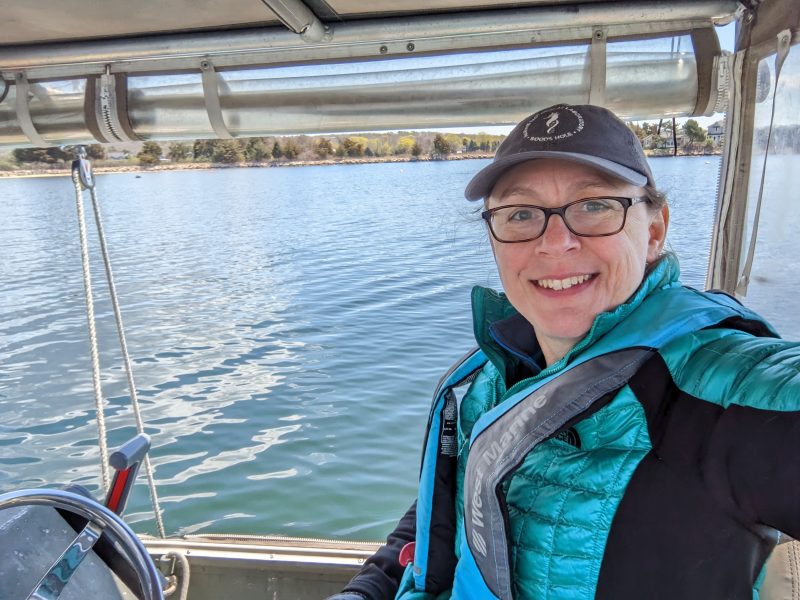
Melanie Hayn on West Falmouth Harbor
Eelgrass is an important part of healthy ecosystems – providing habitat for fish and shellfish, absorbing climate-warming carbon, producing oxygen, and protecting the coastline from storms. Eelgrass has been lost in many areas around Buzzards Bay. Hayn will examine sediment characteristics in areas around Buzzards Bay where eelgrass coverage is either expanding or has been lost. Her work will will help understand what sediment conditions are needed for eelgrass restoration to succeed.
Hayn attributes her research success to date to collaborations with many local organizations through her work at MBL, including CR Environmental, USGS, WHOI, Falmouth Wastewater Division, and EP Oceanographic. She is also very familiar with the “great long-term data set” that the Coalition has collected for decades as well.
She has been working locally long enough to observe the effects the water treatment plant has had in West Falmouth Harbor; the total nitrogen loading is now down 25% from its peak. She will continue to study this through her fellowship.
Even though she grew up in Connecticut, her roots in this area run deep. Hayn spent summers going to the Cape, specifically her grandparents’ house in Dennis. She sought out the West Falmouth opportunity with MBL specifically because of her childhood experiences here.
She is passionate for the community in other ways, too. The Pocasset resident is involved in the local arts community, being president of the Falmouth Players Chamber Orchestra. “While many people in town might know me as a scientist, many people also know me as ‘that oboist,’” she says.
Hayn is excited to get to work, continuing her research and lending her expertise at the Coalition.